
Enough

Dear ones,
Sardines were a favourite of my grandfather.
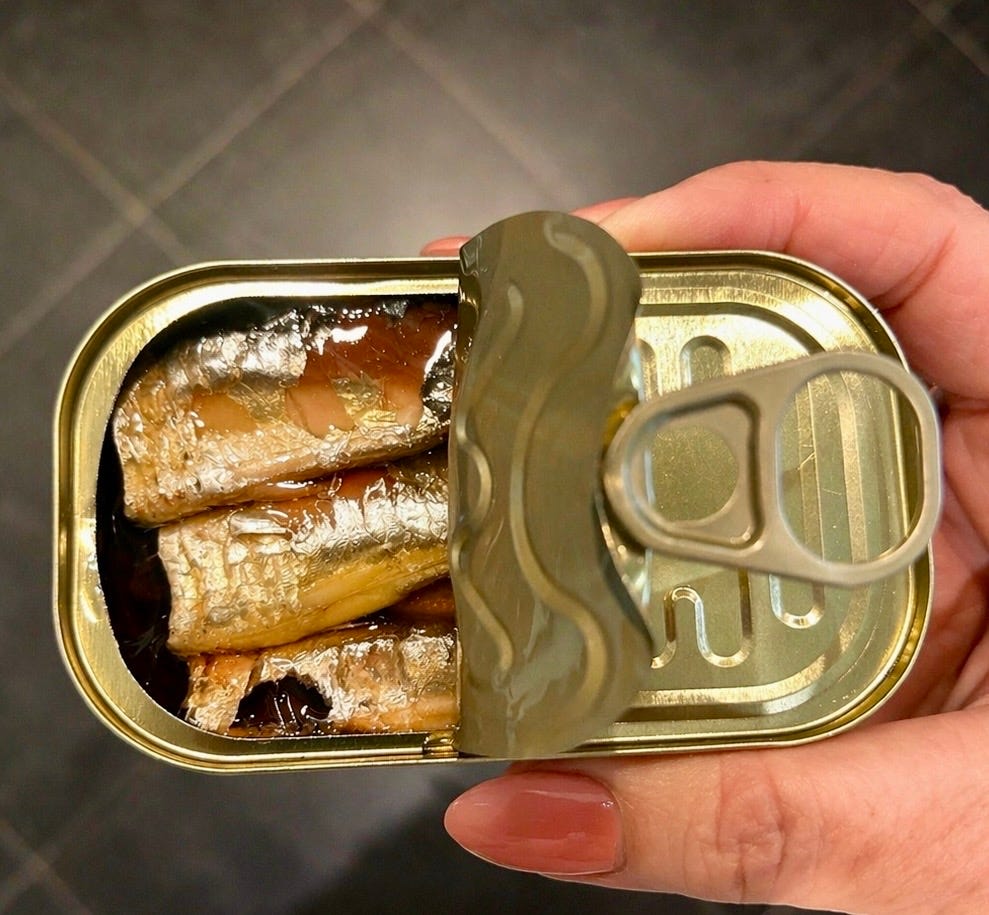
I remember looking up at him standing at the kitchen counter, peeling back the tin—that soft metallic pull—releasing the odour of those little fish, salty, a little sharp, ocean-deep, into the room.
He would scoop the sardines onto a dry piece of toast. No butter. No garnish. No apology. He would devour them.
Just simple. Just enough.
There was something steady about the way he did it. The same motion. The same meal. A certainty.
At the time, I didn’t think much of it. It was just something smelly that my grandfather ate.
But lately I’ve noticed something else.
Sardines are trending.
Yes, the tiny fish in the can have come back around.
They’re everywhere again—touted as the latest superfood. Experts talk about omega-3s, selenium, heart health, and brain health. NBC has reported that sardines have even been called “skincare in a can,” with promises of glowing skin, weight loss, and longevity. There’s the Sardine Diet, fashion trends featuring sardine-printed dresses, beaded sardine bags, and fish-themed jewelry. YouTube videos, articles, recipes—even entire communities built around things like “tinned-fish date nights.”
The tins themselves have been rebranded with enticing, artistic packaging, all in an effort to cash in on the craze. As one recent Business Insider article put it, “Sardines have been rebranded as a sexy, convenient superfood with premium packaging and a price to match.”
It’s interesting how we rename things, because back in the late 1960s, my grandfather didn’t eat sardines for any of those reasons.
My grandfather was born in 1895. He lived through the Depression as a working adult, in his mid-30s to mid-40s—right in the years when a person is building a life, supporting a family, and making things stretch. He most likely didn’t eat sardines because they were sexy. He ate them because they were easy, inexpensive, and dependable in a time that wasn’t.
I recently saw a Canadian grocery ad from the 1960s showing Brunswick sardines at four tins for 19 cents. The tin in the photo cost $5.29.
Sardines were easy. They didn’t require a can opener, they kept well in the cupboard, and they filled him up.
A small tin of fish.
A piece of dry toast.
Enough.
And now, all these years later, we circle back—with our language and our labels—and someone, somewhere, saw a marketing opportunity in sardines and called it a secret. A solution. A miracle food.
But maybe it was never a secret.
Maybe it was just survival—practical, plain, unadorned.
A tin opened at the kitchen table, no story needed, no explanation offered.
Just something that worked, long before we learned how to talk about it.
And maybe there’s something in that worth remembering.
Our grandfathers and grandmothers lived simply and ate what worked—what lasted, what nourished, what got them through.
They didn’t need a story to justify it.
They didn’t need a vibrant, sexy label to trust it.
And somehow, they knew a thing or two without ever being told.
Not everything that nourishes us needs to be optimized or explained.
Some things were already doing their job long before we learned how to praise them.
A Blessing for You
May you never overlook the ordinary ways your life is already being nourished. May you trust what is simple and enough.
With love,
Mary Ann
Sources
American Heart Association — Fish and Omega-3 Fatty Acids
Business Insider Fish Wife Article Business Insider
NBC News Article “Skincare in a Can” NBC Article
Schaltegger, Megan. (2024). What Is the Sardine Diet? Delish. Sardine Diet
Photo credit; Mary Ann Burrows 2026
If you enjoy my writing, pull up a chair and stay awhile.
Thank you for being here.
Share with a friend that may need to read this
For more of my work visit me at Mary Ann Burrows
I agree
Sardines on toast - a true comfort food.